One of the world's greatest expeditions, translated into English for the first time, from the 1848–75 first edition.
LT·007 · DE · Russia · 1848–75 · Science / Natural History
The account as written · German, 1848–75
Reise in den äussersten Norden und Osten Sibiriens
- Author
- Alexander von Middendorff
- First published
- 1848–75 · Russia
- Written in
- Deutsch (German)
- Status
- First English Translation
- Stage
- Permafrost volume · translation complete
Our English edition · first, after 178 years
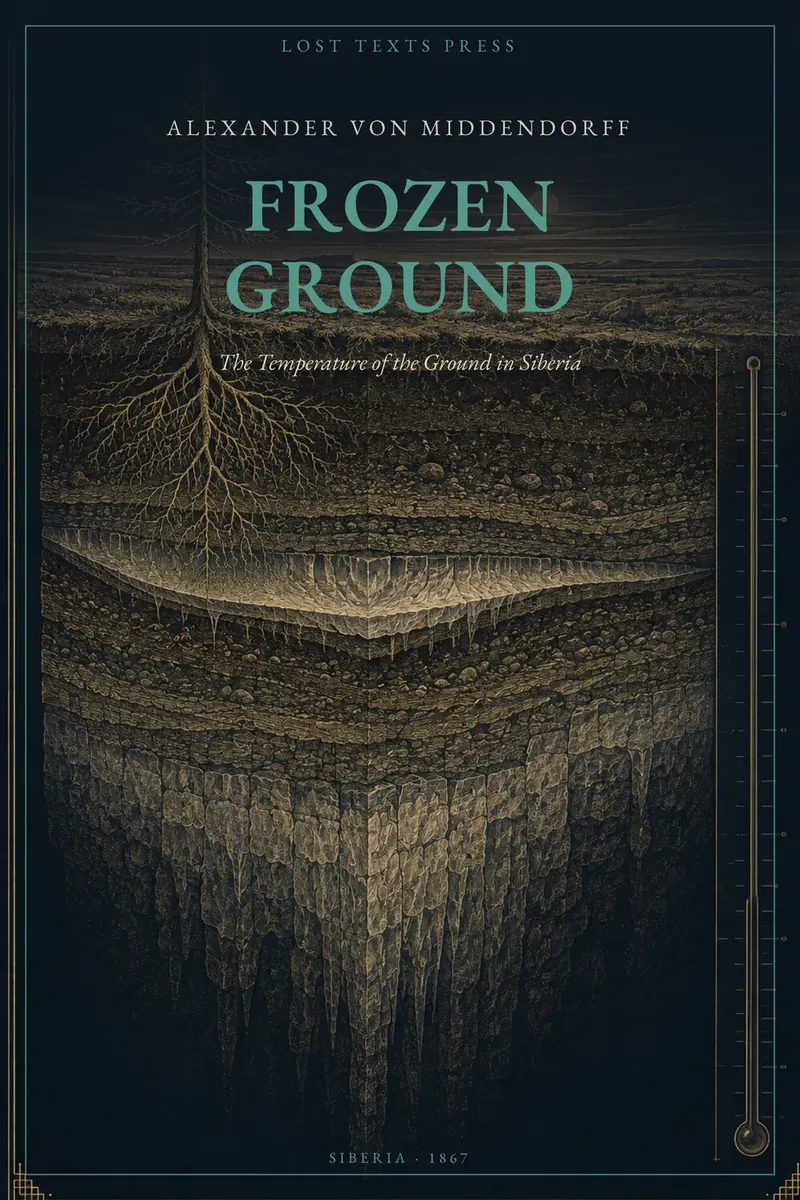
Frozen Ground
A merchant at Yakutsk dug for ten years and never reached water. He went down more than a hundred metres through ground frozen solid the whole way, then gave up and left the shaft open. Twenty years later Middendorff looked into the hole and saw an instrument nobody had thought to read. He lowered thermometers into it and founded a science.
What he got out of the hole is the founding document of permafrost science: a measured temperature profile of permanently frozen ground, and from its gradient an estimate of how deep the freeze runs. Far deeper than the shaft. Deeper than anyone had supposed. This volume is the chapter, translated complete for the first time, with his account of the aufeis and the ice valleys of Siberia.
The book reads as modern. Middendorff asks in 1848 how thick the frozen layer runs, how fast it answers to the surface, and what happens to the ground when it thaws. Those are the questions the Arctic gets now. He asked them with a thermometer on a string.
The jacket · as it will be printed
Frozen Ground
The whole is a single, coherent mass of ice-cemented earth, whose lower limit no one has yet reached.
On the frozen ground beneath Yakutsk
Back cover
A merchant dug a well and failed. Ten years of work, a shaft driven more than a hundred metres into the ground beneath Yakutsk, and no water at any depth. He found earth frozen hard as rock, all the way to the bottom. He left the hole open, and people forgot it.
Twenty years later a naturalist on his way to the Taimyr looked into it and understood what it was: a borehole into a frozen world, already dug, waiting to be read. Middendorff hung thermometers at intervals down the shaft and left them. The numbers he brought up are the first measured profile of permanently frozen ground anywhere, and from the rate at which they warmed with depth he reasoned out how far below the shaft the freeze must reach.
The answer: Siberia is frozen to a depth no one had supposed. The frost is not a winter skin. It is a permanent structure of the continent, older than any season, inherited rather than made.
Around this sits the rest of his frozen world: the aufeis sheets that flood and refreeze across a valley floor through the whole of a winter, the ice that lifts riverbeds and turns a road into a glacier, the ground that heaves and cracks and sorts itself into patterns. He measured what he could and described what he could not, and where he could not decide, he says so.
St Petersburg, 1848. The book which named the frozen ground. Unread in English for a hundred and seventy-eight years, while the ground it describes begins to thaw.
Inside cover
Middendorff went north in 1842 for the Imperial Academy of Sciences, crossed the Taimyr peninsula, very nearly died there, and came back with material he spent the next twenty-seven years writing up. The Reise ran to four volumes and became an encyclopaedia of Siberia. This edition takes the part of it that matters most now and has never been available in English at all.
Nobody believed him. More precisely, nobody held a framework in which permanently frozen ground made sense. Frost was seasonal. Any deep freeze had to be a relic soon to vanish. Reports from Siberia were a hard winter, exaggerated. Middendorff stopped arguing and started measuring. He kept the thermometer readings and his own inferences strictly apart.
His care is easy to miss. Where air circulating in the open shaft disturbs a reading, he says so. Where his extrapolation rests on a uniform gradient he has no way to verify, he says so. He offers the total depth as an estimate, with its assumptions on the page. This is why it has held up.
The second half of the volume is the aufeis: the ice that forms when water under pressure breaks through a frozen river surface, spreads, freezes, and does it again, until a valley floor carries metres of layered ice that survives into summer. He works out the mechanism, follows the ice through a season, and describes the effect on travel, on rivers, and on the ground beneath.
Translated complete from the St Petersburg edition, with every one of Middendorff's own footnotes. His temperatures are Réaumur, given as he wrote them, with the Celsius equivalent supplied. His Russian units stay as he set them, the sazhen, the verst and the pood, converted in the notes. Where the scan is damaged, we record the damage instead of smoothing it over.
- First English translation
- Translated from the St Petersburg edition of 1848
- Band IV, Theil 1 · nine divisions · 135 pages
- 142 footnotes, Middendorff's own and editorial, marked apart
- Réaumur temperatures and Russian units converted in the notes
- Every reconstruction from the damaged scan recorded
The first English edition in 178 years.