One of the world's greatest expeditions, translated into English for the first time, from the 1843 first edition.
LT·001 · FR · France · 1843 · Exploration / Natural History
The account as written · French, 1843
Asie centrale
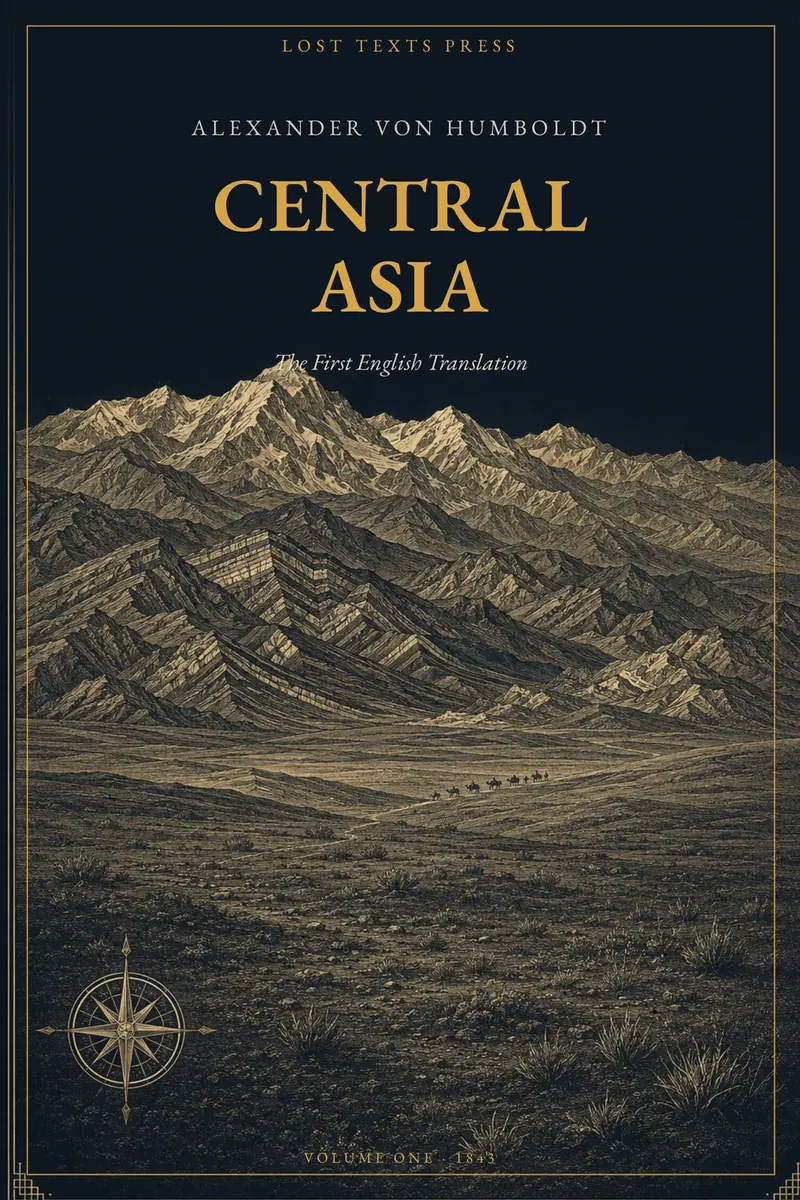
- Author
- Alexander von Humboldt
- First published
- 1843 · France
- Written in
- Français (French)
- Status
- First English Translation
- Stage
- Volume One · translation complete
Our English edition · first, after 183 years
Alexander von Humboldt in Central Asia
Before he left Berlin, Humboldt told the Russians they would find diamonds in the Ural gold washings. He had never been there. He reasoned it from the rock of the Brazilian diamond fields. Weeks after he passed through, they found one. He was sixty, he covered 9,600 miles in twenty-five weeks, and he came home with the book nobody carried into English.
The result was Asie centrale (Paris, 1843), a study of the mountain chains and climate of the Asian interior. In it Humboldt calls for a network of weather and geomagnetic stations across the continent, a founding idea of modern climate science. With the Fragments de géologie et de climatologie asiatiques, it is the only major Humboldt voyage never assembled in English. This edition renders it for the first time.
The jacket · as it will be printed
Alexander von Humboldt in Central Asia
To interrogate nature in this long series of ancient and modern formations, which are superposed upon and mutually penetrate one another — to sound in this way both space and time — is to rise to the search for great geological laws; it is to recognise what there is of stable and uniform in phenomena circumscribed and variable in appearance.
Volume One, closing the chapter on the Urals
Back cover
In spring 1829 the Tsar of Russia paid for a journey. Alexander von Humboldt was sixty, and the most famous scientist alive. He left St Petersburg with a barometer, a magnetic needle and two colleagues. He did not stop until he had crossed 9,600 miles of the empire in twenty-five weeks: the Urals, the Altai, the Chinese frontier, the Caspian steppe.
Asie centrale is what he made of it. Before leaving he predicted, from the geology of the Brazilian diamond fields, diamonds in the gold washings of the Urals. They turned up within weeks of his passing through. At Nevyansk he went looking for the girl who found the nugget starting the Ural gold rush of 1813. He found her, and put her married name in a footnote. He measured the range for a thousand miles and then reported he had no way to say where it began. The post road over the boundary between Europe and Asia climbs less than the margin of error in his instruments.
The book asks how a thing comes to be known. What a barometer settles, and what it leaves open. How Herodotus reads against a relief map, and why the gold of the griffins lies where the itinerary puts it. Why five men measured one mountain and brought back five different heights. The error was not in the mountain. It was in the town at its foot.
Out of it came his call for a chain of magnetic and meteorological stations strung across a continent: the founding idea of observing a planet as a single system.
Paris, 1843. Read for a century in French. Never once, in a hundred and eighty-three years, in English.
Inside cover
You know the American voyage: the Orinoco, Chimborazo, the five years making his name. This is the other one. He made it thirty years later, at the far end of a long life, across an empire rather than a wilderness. It went into German the following year, revised as it went, so the Berlin edition of 1844 carries additions the Paris one lacks. It went into Russian after that. It never went into English.
The invitation came from Georg von Cancrin, the Tsar's finance minister. He wanted advice on whether Russia should mint platinum, a metal then known almost nowhere but the Colombian Chocó and the Ural washings. Humboldt named his terms, took his instruments, and turned a consulting errand into the last great expedition of his life. His hosts asked him to keep off Russian social conditions. He kept his word in print, and wrote what he came to write.
Here is what he came to write. The interior of Asia is not the single vast tableland every atlas then showed. It is a structure of mountain systems running in fixed directions. You trace them by the strike of their strata and the metals in their veins, even where the ground lies too low to see them. Volume One is the argument: the general geology of Asia, the Altai, the Kuznetsk and Salair ranges, and then, for half its length, the Urals. He measures them, dates them, argues with them, and sets them beside the gold fields of Brazil, the Chocó, Mexico, the Alleghanies and Hispaniola. He never describes one range without weighing it against every other he walked.
He is at his best in the footnotes, where the book keeps turning out to be about people. The boy who found the first Russian diamond. A girl in a Nevyansk village and the man she married. Five surveyors disagreeing about a hill. Peter the Great unrolling a map of the Caspian. Two Spanish officials of the 1520s, watching gold washed out of Hispaniola, reasoning about it nearly as well as his own century did. Humboldt says so plainly. On the one point where he corrects them, they were right and he was wrong.
This edition renders the complete first volume from the Paris first edition of 1843. Every one of Humboldt's own footnotes appears, with his citations as he gave them. Editorial notes are marked and kept out of his voice. Where the surviving scan is damaged, we record the damage instead of smoothing it over.
- First complete English translation
- Translated from the first edition, Paris: Gide, 1843
- Volume One of three · 63 sections
- 528 of Humboldt's own footnotes, all preserved
- 155 editorial notes, marked as such
- Every reconstruction from the damaged scan recorded
The first English edition in 183 years.